



Happy New Year to the fellow members of the Valuing Water Community! I appreciate and look forward to the opportunities of learning and sharing as a new member of this community. We are lucky to have snow over the nearby mountain top after two weeks of rainstorm/windstorm which will be helpful for the mountain ecosystems. I just posted an event for your infomation about what we are doing now as part of CIEDM's grassroots actions of taking part in the celebration of the 2026 National Bird Day on 5 January and International Zero Waste Month throughout January, and welcome your comments.
-
Saida Rivero created an event in Global Community
-
Saida Rivero created new community content in Global Community
-
Edward Huang posted in Valuing Water Community
il y a 3 weeks Public
-
Edward Huang created an event in Valuing Water Community
-
Saida Rivero created new community content in Global Community
-
Saida Rivero created new community content in Latin America and the Caribbean Community
-
Suyu Liu posted in Africa Community
il y a 1 month PublicBicycles help Zambian farmers push out through deought
see this news on The Times: https://www.thetimes.com/uk/education/article/zambian-farmers-conservat…
-
Edward Huang created a new resource in Global Community.
-
Edward Huang created a new resource in Global Community.
-
Dieudonne ILBOUDO posted in Africa Community
il y a 1 month PublicThe importance of hedgerows in combating desertification
A hedgerow is a dense, continuous linear formation consisting of one or more rows of shrubs around a site to be protected from animals and other threats. It plays a vital role in the fight against desertification by protecting soils from wind and water erosion, improving soil fertility, and conserving moisture. They act as natural barriers that reduce land degradation, enhance biodiversity, and create favorable microclimates for crops and livestock. By stabilizing ecosystems and supporting sustainable land management, living hedges contribute significantly to the resilience of rural landscapes and communities facing climate change.
1. Objectives
The establishment of hedgerows aims to contribute sustainably to combat desertification in the Sahel region through the following objectives :
Protecting production areas (gardens, orchards, cultivated fields) from stray livestock and associated damage ;
Demarcating and securing agricultural land, plots, access corridors, and developed areas to reduce land pressure ;
Effectively combating wind and water erosion by reducing wind speed and water runoff;
Reducing deforestation and illegal logging through a renewable plant source ;
Preventing and mitigating land and agropastoral conflicts related to access to and use of land and natural resources;
Restoring degraded land and improving the resilience of agrosilvopastoral systems to the effects of climate change.2. Context and Environmental Conditions
Hedgerows are a proven soil and water conservation technique, widely used in Sahelian agropastoral zones characterized by annual rainfall between 300 and 600 mm.
In these fragile environments, highly exposed to desertification, hedgerows help to slow desertification, stabilize soils, protect crops, and promote vegetation regeneration. They thus constitute a sustainable, low-cost solution adapted to local knowledge for integrated land management.3. Implementation Steps
The establishment of hedgerows follows a gradual process adapted to the local agricultural calendar:
Production of seedlings in a nursery using species adapted to local climatic conditions;
Marking planting lines for optimal spatial organization;
Soil preparation and digging of planting holes (April–May) to anticipate the rainy season;
Transportation of seedlings to planting sites;
Plant or direct sowing at the beginning of the rainy season (June–July) to ensure better establishment and survival of the seedlings.4. Technical Specifications for Planting
Planting Holes:
Diameter: 40 cm
Depth: 60 cm
Spacing between plants: 30 to 100 cm depending on the species used ;
Spacing between rows: 50 cm ;
Arrangement: 1 to 3 rows of plants arranged in a staggered pattern to increase effectiveness against wind, erosion, and animal passage.5. Characteristics of Forest Species Adapted to Combating Desertification
The species selected for hedgerows must meet the following criteria:
Ability to grow in rows and at high density;
Ability to regenerate vigorously after frequent cutting;
Ease of propagation and maintenance using techniques accessible to local producers;
No toxicity to surrounding crops;
High hardiness and rapid initial growth in arid conditions ;
Thorny and unpalatable to livestock;
Shrubby habit with dense branching providing good protection ;
Taproot system limiting water competition with crops.6. Commonly Used Species
In the Sahelian context of combating desertification, the most commonly used species for hedgerows are :
Bauhinia rufescens, Acacia senegal, Acacia laeta, Acacia nilotica, Acacia ataxacantha, Ziziphus mauritiana, Combretum aculeatum, Mimosa pigra, Lawsonia inermis, Jatropha curcas, Euphorbia balsamifera, and Prosopis juliflora.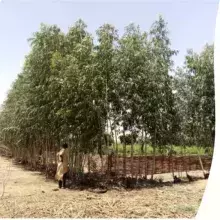




-
Suyu Liu posted in Asia Community
il y a 1 month PublicThis is an interesting article, fulltext here: https://doi.org/10.1029/2025EF005971
A Tale of Two Unprecedented Droughts in Southeast Asia: Physical Drivers and Impending Future Risks
Authored by: Shuping Ma, Xiao Peng, Xinyue Liu, Zhongwang Wei, Zhixiao Niu, Wenpeng Zhao, Ming Pan, Xiaogang He
Abstract: Conventional wisdom suggests that tropical droughts in Southeast Asia are closely linked to natural climate variability like El Niño. However, the extreme 2014 drought occurred independently of El Niño, suggesting other dynamic forcings at play. Here we use moisture budget analysis, moisture tracking, and physics-informed joint probability modeling to disentangle the interplay between dynamic and thermodynamic drivers behind this unprecedented drought and to assess future drought risks under climate change. We find that the 2014 drought primarily resulted from air subsidence due to anticyclone-driven mid-troposphere divergence, leading to significant precipitation deficits, which are further intensified by reduced marine moisture inflow from the West Pacific. Incorporating the dynamic and thermodynamic drivers into our bivariate probabilistic analysis, we find that the likelihood of 2014-like droughts will increase by 25% and 43% under stabilized and business as usual pathways, respectively, by mid-century (2030–2064). Such increases in drought risk are dominated by climate-change-induced changes in dynamic processes, particularly reduced mid-troposphere vertical motion, where thermodynamic processes and the dependence structure between the two play a less significant role. However, significant inter-model inconsistence in attributing the relative importance of these factors highlights the challenges of using current climate models for robust risk assessment.
Plain Language Summary
In early 2014, Southeast Asia experienced an extreme drought. Our analysis explores the role of the intricate interplay between dynamic and thermodynamic processes in drought formation. We find that the probability of experiencing droughts similar to the 2014 event increases by 25% under the SSP126 scenario compared to historical likelihood, and under the SSP585 scenario, this increase is even more pronounced at 43%, when employing vertical motion and relative humidity to describe the combined effect of the thermodynamic and dynamic processes. Overall, we anticipate a significant increase in the frequency of extreme drought conditions under more severe warming scenarios, with the dynamic factors mainly contributing to the increased likelihood of 2014-like droughts in the future.Key Points
We explore the intricate interactions among the physical mechanisms that contribute to the historic 2014 Southeast Asia drought
The extreme drought, characterized by the interplay of vertical motion and relative humidity, has a “likely” return period of 95 years
The frequency of extreme drought conditions will increase by 25% and 43% under future scenarios, with dynamical factors playing a key role
-
Saida Rivero created new community content in Latin America and the Caribbean Community
-
Saida Rivero created new community content in Global Community
-
Saida Rivero created new community content in Latin America and the Caribbean Community
-
Saida Rivero created new community content in Global Community
-
il y a 1 month Public
Thinking about the COP 17 has a theme of pasture land management, I think the following is an interesting article.
Pasture Degradation Estimates Through Field Data in the State of Goiás, Brazil
Authored by: Nathalia Teles, Vinicius Mesquita, Luis Baumann, Wilton Ladeira da Silva, Ana Andrade, Laerte Ferreira
ABSTRACT
Grasslands and pastures play a critical role in global food security, biodiversity, and ecosystem services, particularly in tropical regions where they serve as the primary base for livestock production. However, these areas are increasingly vulnerable to degradation due to poor management practices, as observed in the Cerrado biome. This study focuses on pastures in Goiás, a state located in central-western Brazil, which relies heavily on pastures for its agricultural economy. We present a comprehensive field-based assessment of pasture degradation in Goiás, aiming to estimate the area of degraded pasture according to three categories: non-degraded, in process of degradation, and severely degraded. A three-stage cluster sampling design was employed to evaluate 460 field points, incorporating visual assessments of key variables using the novel Pasture Assessment Score (PAS). The sample size was determined to achieve a maximum expected standard error of 4.47% for the estimated proportion of pasture area across the three degradation levels, calculated using the Monte Carlo method. The scores were analyzed using Multiple Correspondence Analysis (MCA) to reduce dimensionality and identify clusters corresponding to degradation levels, which were modeled using Decision Trees. The results revealed that 39.35% (SE = 3.92%) of the pasture area in Goiás was classified as non-degraded, 31.98% (SE = 2.66%) as being in process of degradation, and 28.67% (SE = 3.64%) as severely degraded. These findings underscore the need for targeted management strategies and enhanced monitoring frameworks integrating field-based assessments with remote sensing data to support sustainable pasture management.The link to fulltext is: https://doi.org/10.1002/ldr.70089
-
Suyu Liu created new community content in Asia Community
-
Suyu Liu created new community content in Asia Community
-
Sabina Bokal created new community content in Integrated Drought Management Programme
-
Salman Zare posted in Asia Community
il y a 1 month PublicA New Approach to Improving Drought Resilience in Desert Ecosystem Restoration
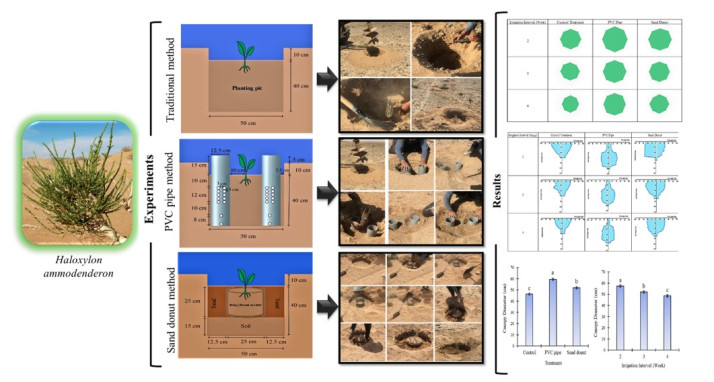
Recurring drought and accelerating desertification are placing increasing pressure on dryland ecosystems, leading to reduced vegetation cover, soil degradation, and the decline of essential ecosystem functions. Under these conditions, ecological restoration—ranging from soil stabilization to the re-establishment of protective plant cover—has become both urgent and increasingly challenging due to limited water availability.
One practical response to this challenge is the use of deep root-zone irrigation, a technique that delivers water directly to subsurface soil layers where plant roots are most active. By reducing surface wetting, this approach helps limit water losses through evaporation and runoff while improving plant access to moisture under drought conditions.
Building on this concept, our research team has applied the pipe method as a targeted deep-irrigation solution. In this method, irrigation water is conveyed through a perforated pipe and released within the root zone, creating a deeper and more stable moisture distribution compared with conventional surface irrigation. This results in more efficient water use, improved soil moisture conditions, and stronger plant establishment in water-limited environments.
The findings show that the pipe method can contribute to more resilient restoration outcomes by combining water savings with improved plant performance.
Details of this work have been published in the journal Land Degradation & Development.
https://doi.org/10.1002/ldr.70076